
Essay
No. 038
19 February 2026
15 min read
Strategy
"When a measure becomes a target, it ceases to be a good measure." — Goodhart's law
In nature, the Fibonacci sequence is everywhere. Each number is the sum of the two before it — 1, 1, 2, 3, 5, 8, 13, 21 — creating a spiral that expands outward with elegant, accelerating momentum. You see it in nautilus shells, sunflower heads, galaxy arms. It’s the geometry of compounding growth: each stage building on the previous ones to produce something larger, more complex, more alive.
Healthy business functions work the same way. Strong positioning strengthens brand perception. Brand perception lowers customer acquisition cost. Lower CAC funds deeper strategic investment. That investment sharpens positioning further. Each cycle compounds the one before it, creating an expanding spiral of increasing returns.
Now imagine a different kind of spiral. One that compounds with the same accelerating rhythm — but in the wrong direction. With every turn, the function’s strategic territory shrinks, while it produces more activity, more campaigns, more leads, more dashboards, more noise. More measurement, less influence. More output, less power. The spiral grows louder while getting smaller.
That is the story of marketing in SaaS over the last fifteen years. And it didn’t happen by accident. It happened through optimization — rigorous, measurable, well-intentioned optimization — toward the wrong objective. Like any algorithm trained on the wrong loss function, the system converged efficiently — and reached a strategic dead end.

To understand how this happened, you have to start with a deceptively simple distinction: the difference between a system and its outputs. Revenue is an output. Pipeline is an output. CAC, win rates, sales velocity — all outputs. They are signals that tell you whether your underlying system — product, positioning, pricing, distribution, brand, sales execution — is healthy. They’re thermometers, not the weather. You don’t change the weather by manipulating the thermometer.
This is Goodhart’s Law in action: the moment a measure becomes a target, it ceases to be a good measure. And this is precisely what most SaaS organizations have done to marketing. They took a function meant to shape the system, a function that operates across strategy, product, pricing, distribution, and communication, and they reduced its entire mandate to a single output metric: pipeline.
Pipeline became the target. Not the indicator. The target.
That single change set off a chain reaction that has been compounding for over a decade. Marketing shifted overwhelmingly toward demand capture — converting existing intent through campaigns, leads, and attribution — at the expense of demand creation — shaping markets, building categories, and establishing the brand preference that makes future demand cheaper and more durable. This imbalance is the engine of the contraction spiral.
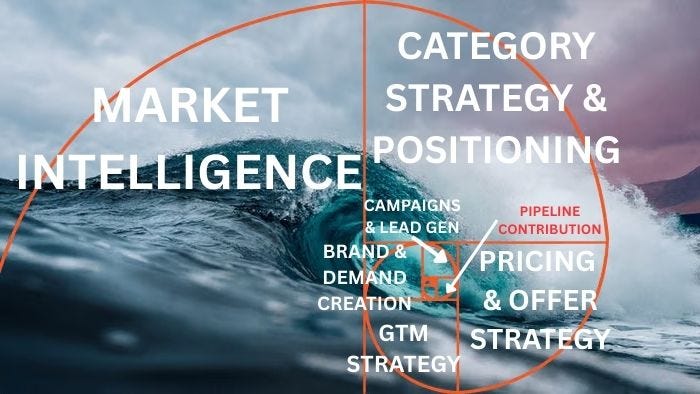
To understand how we got here, you need to go back to roughly 2010–2015, when SaaS was maturing as a business model, and marketing was searching for its place at the leadership table.
The challenge was real. In earlier eras, marketing’s value was largely taken on faith. Brand campaigns ran, events happened, content was produced, and the connection to revenue was assumed rather than proved. In a SaaS world increasingly dominated by metrics, unit economics, and investor scrutiny, that was no longer sufficient. Boards wanted to know what marketing contributed. CEOs wanted accountability. CFOs wanted measurable returns.
Marketing responded by doing something that seemed entirely logical: it made itself measurable. A rapidly growing MarTech industry gave the function an ever-expanding arsenal of tools to track leads, score them, attribute them to specific campaigns, and report on every stage of the funnel. MQLs, SQLs, marketing-sourced pipeline, influenced revenue: an entire vocabulary of measurement emerged, and marketing leaders embraced it enthusiastically. The approach worked. Companies grew. Budgets were justified. And that success made measurable demand generation the default operating model for an entire industry.
This was the Faustian bargain, though nobody recognized it at the time. The correction overshot. By defining its value in pipeline terms, marketing earned short-term credibility. Budgets grew. Teams expanded. The CMO got a seat at the revenue table. But the implicit agreement was devastating: marketing had accepted that its value equaled its measurable contribution to pipeline. Once pipeline became marketing’s objective rather than its output, everything else — positioning, market intelligence, competitive strategy, brand, pricing insight, category creation — drifted into the background, because none of it showed up on the pipeline dashboard. Over time, marketing stopped owning the system that produces pipeline, even as it remained accountable for producing pipeline itself and hitting the numbers.
What makes this dynamic so destructive is that each contraction enables and accelerates the next. Like a Fibonacci sequence where each term builds on the previous two, each turn of the spiral compounds the ones that came before. But the direction is wrong: each adaptation narrowed the function slightly while making that narrowing feel like progress. Like a machine learning model optimizing the wrong objective, the system became increasingly efficient at producing the wrong outcome: more activity, less relevance, with every cycle.
In early-stage SaaS, founders naturally own positioning, market strategy, and sometimes pricing, because they have to. But the pattern doesn’t end when the company matures. In PE-owned companies, operating partners and the executive team retain strategic control. In publicly traded SaaS, the CEO and board set market direction. At every stage, the dynamic is the same: strategic ownership lives at the top. And when marketing is hired or restructured, those responsibilities don’t transfer. Not because anyone explicitly decided to withhold them, but because marketing arrived into a mandate defined by pipeline generation — and never claimed the rest, because claiming it would mean fighting for work that doesn’t show up on the dashboard it’s being judged by.
SaaS marketing embraced measurable demand generation as its default model and pipeline as its primary metric. It lost ownership of the upstream system that creates pipeline, but remained accountable for producing it and hitting the numbers.
Most SaaS companies do have product marketing managers, strategy leads, and enablement teams sitting under the CMO. On paper, marketing has strategic capability. In practice, these roles spend most of their time translating and justifying decisions that were already made — by the CEO, the board, finance, or product leadership. Positioning is validated, not originated. Pricing is communicated, not shaped. And regardless of the diversity of roles and titles within marketing, the function is ultimately judged on one number: pipeline. Everything else is activity. Only pipeline counts.
As SaaS organizations scale, the integrative role marketing once played — maintaining coherence across the entire market-facing system — begins to fragment. Specialization emerges; each segment of the funnel becomes its own operational domain.
Product marketing gets pulled into the product organization.
Product teams absorb pricing architecture and offer strategy because they're closest to the build.
Finance controls pricing levels because they own the P&L.
Retention and expansion move to Customer Success.
Sales enablement migrates to revenue leadership.
Growth teams optimize acquisition loops.
Marketing Operations manages the tech stack and all measurements.
In product-led growth companies, the pattern is even more pronounced — product teams absorb acquisition, onboarding, and conversion optimization entirely, and marketing’s role shrinks to a supporting function or disappears from the growth loop altogether. This doesn’t mean PLG eliminated the need for market strategy. It relocated it. The strategic functions — positioning, differentiation, understanding buyer psychology — still exist in successful PLG companies. They just live in product. Which is itself evidence of the dissolution pattern: the work persists, but marketing no longer owns it.
A function with a shrinking mandate does the rational thing: it doubles down on its remaining territory and visible activity. More campaigns. More leads. More attribution models. More channels activated. More dashboards proving the value of the work that’s left. And because activity remains measurable, it reinforces the perception that this is where marketing’s value resides. From the inside, it feels like acceleration. From the outside, it looks like a function running faster with nowhere to go. The algorithm is optimizing beautifully. It’s just optimizing for the wrong thing.
Walk into any SaaS organization, and one of the first things a new marketing leader will do is open the dashboards. They rebuild them. Clean definitions. Standardize funnel stages. Refine attribution windows. Create visibility. Align pipeline reporting with revenue expectations.
This feels like progress. And in many ways, it is. Dashboards bring clarity. They make performance legible. They create the sense that the system is under control. But dashboards do something else, too. They define what is visible — and by extension, what is real. Pipeline, conversion rates, channel performance become the territory. Positioning strength, category authority, narrative resonance do not appear on the dashboard. Under pipeline pressure, the organization begins to optimize toward what it can see. The strategic work doesn’t get formally eliminated. It just gradually loses headcount, investment, and executive attention. Demand creation — the slow, compounding work of shaping how markets think — quietly starves while demand capture consumes every available resource.
Dashboards do not just reflect the system. They begin to redefine it. Pipeline becomes the territory. Everything else becomes background.
The final shift is perceptual, not operational. Because marketing no longer visibly owns the structural integrity of the system, it quietly moves from being seen as a strategic function to being seen as an execution function. This changes every future conversation about its value.
When a function is strategic, cutting it creates visible, dangerous gaps. Leadership thinks twice. When a function is execution, cutting it means fewer campaigns — which feels optimizable. You’re no longer debating whether to defund a strategic capability. You’re debating whether fifteen people could be eight with better automation.
The function didn’t just lose scope. It lost its organizational immune system — the strategic indispensability that protects against being treated as an adjustable expense. Not because marketing stopped mattering. But because its systemic role had become invisible.
If you step back far enough to see the full shape of this contraction, the picture is striking.
Marketing was designed to be the architect of growth : the function that sees the full structure, understands how positioning connects to product connects to pricing connects to distribution, and designs the system that makes all of it work together.
What remains, in many SaaS organizations, is a function that paints walls. The campaigns are well-executed. The content is polished. The events run smoothly. The colors are on-brand. But the architecture — the structural decisions about who we’re for, why they should care, how we’re different, what we should build, and how we should price it — is being designed by other people, in other rooms, in meetings that marketing isn’t invited to.
The organization hired an architect, handed them a paint roller, measured them on square meters of wall covered per quarter, and then wondered why the building keeps cracking.
The deepest irony of this story is that the very thing that was supposed to elevate marketing — measurement — became the mechanism of its reduction. But measurement alone doesn’t explain the full picture. What measurement did was create a power asymmetry: it gave other functions the instrument to reclaim or retain strategic authority.
Pipeline is the downstream result of upstream conditions — product quality, category demand, positioning strength, and pricing fit. By accepting pipeline as its primary metric, marketing became accountable for outcomes shaped by decisions it didn’t control. And it gave other functions the structural justification to keep the strategic levers, precisely because those levers were harder to measure. This is fundamentally a power asymmetry problem disguised as a measurement problem.
Consider the asymmetry in practice. Marketing is now the most visibly measured function in most SaaS organizations. Every lead is tracked. Every campaign is attributed. Every dollar of pipeline is assigned to a source. The dashboard updates in real time.
Meanwhile, no one asks product to prove the precise ROI of a specific feature investment with multi-touch attribution. No one asks the CEO to quantify the revenue impact of their conference keynote. No one demands that sales attribute each closed deal to the specific enablement content or competitive battlecard that influenced the buyer. These functions operate with an implicit trust in their value that marketing traded away in exchange for measurable credibility.
And the measurement itself creates distortions, the same way optimizing an algorithm for click-through rate produces clickbait rather than quality content. When every marketing activity must show attributable pipeline impact, the activities that can be easily measured — paid campaigns, gated content, event registrations — get funded. These are demand capture activities. The activities that compound over time but resist attribution — brand building, thought leadership, community, category creation — get starved. These are demand creation activities. Not because anyone decided they don’t matter, but because the optimization function doesn’t see them.
The dashboard becomes a trap. You can see everything that’s measurable. You’re blind to everything that matters most.
The optimization loop didn’t form in isolation. It was accelerated, and in many cases, initiated, by forces external to marketing.
The venture capital model that dominated SaaS from 2010 to 2022 didn’t just create pressure for growth. It created pressure for a specific kind of growth: aggressive, predictable, and detached from market reality. Growth targets were set not by market analysis, by understanding category maturity, competitive density, buyer readiness, or segment saturation, but by financial modeling. A board didn’t ask “what does the market support?” It asked “what multiple do we need at the next round?” and worked backward to a pipeline number.
The targets handed to marketing were reverse-engineered from valuation expectations, not derived from market intelligence. The TAM slide in the pitch deck was a fiction designed to justify the investment thesis, not a genuine assessment of addressable demand. And yet, that fiction became the basis for quarterly pipeline targets that marketing was expected to hit.
A board didn’t ask “What does the market support?” It asked “What multiple do we need at the next round?” and worked backward to a pipeline number.
Because market intelligence was never valued as an input to target-setting, marketing never built the institutional muscle for it. Why invest in deep market research when the targets are predetermined? The VC model didn’t just pressure marketing into short-term execution. It severed the connection between growth targets and market reality, making market intelligence structurally irrelevant to the planning process.
The companies that resisted this pattern — those that defined their category, shaped the market, built communities, and invested in demand creation before scaling a sales motion — are disproportionately the ones that thrived, achieved durable growth, or exited successfully.
The post-2022 efficiency era has, paradoxically, intensified the problem. “Do more with less” sounds like an invitation to be strategic. In practice, it usually means hitting the same aggressive targets with fewer people and less budget. The targets didn’t get more realistic. The resources just got smaller. There’s even less room for the strategic work that compounds when the mandate is quarterly survival on someone else’s terms.
The effects of this decade-long contraction are now showing up across the SaaS industry, though they’re rarely attributed to their actual cause. And they are, almost without exception, the predictable consequences of an industry that over-invested in demand capture and systematically under-invested in demand creation.
Customer acquisition costs have been rising steadily across SaaS. The standard explanation is market saturation and increased competition. But there’s a deeper driver: when every company in a category runs the same demand generation playbook — same paid channels, same gated content, same webinar-to-demo funnel — differentiation collapses and acquisition becomes a bidding war. The strategic work that would have created genuine differentiation — positioning, category creation, brand — was defunded years ago. Rising CAC is the delayed invoice for that decision.
Measurement creates distortions, just as optimizing an algorithm for click-through rate produces clickbait instead of quality content.
Win rates are declining in many segments. The surface explanation is competition. The structural explanation is that marketing lost its ability to shape buyer perception before the sales conversation begins. When marketing is a lead factory rather than a perception engine, buyers arrive at sales conversations without conviction, without preference, without a narrative about why this solution is different. Sales is left to create differentiation in real time, one deal at a time, which is the most expensive and least scalable way to compete.
The CMO role itself is disappearing in some organizations, replaced by Chief Revenue Officers, Chief Growth Officers, or VPs who report to sales leadership. This is often presented as an organizational innovation. It may be more accurately understood as an acknowledgment that the function has been hollowed out to the point where C-level representation is no longer justified by its remaining scope.
These aren’t unrelated trends. They’re the predictable output of a function that spent fifteen years optimizing away its own strategic foundations.
If the spiral is self-reinforcing and can’t be corrected from within the optimization loop, what actually breaks the cycle?
The honest answer is that for many organizations, the correction will come the hard way. The function will continue to fragment until the consequences — incoherent go-to-market execution, rising acquisition costs, declining competitive differentiation — become painful enough to force a structural rethinking. Companies will rediscover, through expensive trial and error, that someone needs to own the integrated view of the market: who are we for, why do they care, how do we reach them, what should we build, how should we price it, and how is the competitive landscape shifting.
They may not call this function “marketing.” It might be reconsolidated under a new title, a new structure, a new mandate. But the need doesn’t disappear when the org chart dissolves it. It just gets painfully rediscovered.
For the organizations that recognize the pattern before the pain forces their hand, the path requires resetting the objective function deliberately. This means three things.
First, rebalance demand capture and demand creation. Measure marketing not only on pipeline generated this quarter but on the conditions that make future pipeline cheaper, faster, and more likely to close. Competitive win rates. Brand-driven inbound as a percentage of total pipeline. Pricing power. Market perception shifts. Time-to-close trends. Expansion rates among customers acquired through different channels. Metrics that reflect whether marketing is building a compounding strategic asset, not just harvesting this quarter’s intent.
Second, align accountability with authority. Pipeline generation can reasonably be marketing’s primary responsibility. Revenue cannot, because revenue is a system output that depends on product-market fit, sales execution, pricing, customer experience, and a dozen other factors beyond marketing’s control. When accountability exceeds authority — when marketing is measured on outcomes shaped by decisions it didn’t make — you don’t get performance. You get politics.
Third, let the architect do what they were trained to do. Give marketing genuine ownership of, or at minimum, structured influence over positioning, segmentation, pricing input, product roadmap feedback, and competitive intelligence. Not as a courtesy. As a recognition that these are market-facing decisions, and marketing is the function structurally closest to the market. And invest in building the strategic capability to match the expanded mandate — because scope without skill is no better than skill without scope.
This is the first article in a series examining how SaaS marketing lost its strategic foundations, what forces created the conditions for this collapse, and what it takes to rebuild.
The reversed Fibonacci was not caused by incompetent marketers or short-sighted CEOs. It happened because a complex system optimized rationally toward the wrong objective, and each cycle of optimization made the next cycle more inevitable. Goodhart’s Law, playing out at the scale of an entire business function, over the span of a decade. Measurement was the accelerant. Power dynamics were the underlying force. And the result was an industry-wide imbalance between demand capture and demand creation whose consequences are now impossible to ignore.
Understanding the mechanism is the first step toward breaking it. The next articles will explore how we measure the wrong things and why, and how even our most sophisticated measurement tools may be constructing narratives rather than revealing truth.
Because the spiral doesn’t reverse by spinning harder. It reverses when the objective changes. For that, someone needs to step back far enough to see the shape of what’s been built, and have the clarity — and the courage — to rewrite the loss function entirely.
This is the first in a series on the structural crisis of marketing in SaaS. Read the Episode 2, Episode 3. Subscribe to follow the argument as it develops.
Keep reading